Shire Psychology and Counselling






Connecting with children, adolescents & adults
www.shirepsych.com.au
|
Shire Psychology and Counselling
Connecting with children, adolescents & adults
|
|
|
Barry and Veronica have decided to start publishing some of their articles, presentations & research papers on topics that may be of interest to the counselling and psychology community and the wider community in general. We would love your feed back . 1. Therapy with Same Sex Couples: Are we really so different? 2: Resilience in the face of trauma
1:
Therapy
and Couples: Are Same Sex Couples so Different? Research paper: What happens when we fall in love? Same Sex couples: Myths, Facts and Fallacies that may visit with couples that visit with you in your counselling room. Table of Contents 2
Stereotypes of gay and lesbians and their relationships: Facts &
Fallacies 2.1
The reality of Gay and Lesbian relationships 2.2
What are the issues from the point of Lesbian and Gay groups? 3
How do same sex couples and heterosexual couples compare and contrast? 3.1
What are the attractors that draw people together to form a relationship? 4
What are the problems that bring couples to counselling?
1 IntroductionRegardless of whether we are looking at a homosexual or heterosexual relationships when humans fall in love there are a number of factors that are key to the attraction that we feel to another. Of most importance are a sense of fun and a sense of humour, intelligence and whether you are a kind, supportive and considerate person. (Felmlee, Orzechowicz, & Fortes, 2008, p. 9) While this is true for all relationships irrespective of sexual orientation a number of stereotypes have been developed within out society which label homosexuals and their relationships as deviant and debased, as sick, odd and aberrant. While same sex couples will experience many of the issues, both positive and negative, experienced by heterosexual couples, there are a number of factors that impact on same sex couples because of their position as an often marginalised group in our society. While we, as counsellors, need to be aware of the similarities between same sex and opposite sex couples we also need to be aware of some of the particular issues that may impact on a homosexual couple because of their sexual orientation and the stereotypes and prejudice that exists in regard to that orientation. In carrying out research for this paper I looked at a number of academic articles but I also visited several web sites run by gay and lesbian organisations. Although these sites are not peer reviewed they provide a window into the beliefs and experiences of people with a gay or lesbian orientation. Their experiences and beliefs are important as it is these, and the emotions generated as a result that impact on their life experience and will be a motivator in prompting them, either as individuals or couples, to visit us in our counselling rooms. 2 Stereotypes of gay and lesbians and their relationships: Facts & FallaciesA number of myths and stereotypes circulate in our society about same sex couples. These include statements such as: ©
Homosexuality is a mental
illness © They are sick & it can be cured ©
Gay men and lesbian women
are all promiscuous ©
Homosexual relationships
only exist for sex © Gay men molest children © Homosexual people are not good parents as they introduce their children to their “lifestyle” © I’ve never spoken to a person who is gay, lesbian or bisexual ©
You can always tell
homosexuals by the way they look or act © Gays and Lesbians don’t have long term relationships (Brown, 2007b; Gay Straight These stereotypes are still prominently debated in society and the mass media with, for example, the Dr Phil show, on the 6th May, 2009, being devoted to how intersex individuals should be treated with some commentators on the show maintaining that “sexual maladjustments”, including homosexuality and intersex individuals, could be converted to “normal heterosexuality” through therapy. Needless to say this assertion was hotly contested. In many nations homosexuality is contested at the political level. Felmlee, et al. (2008, p. 1) cites legislative action proposed in Oregon, USA which sought to make same sex marriages unconstitutional by labelling same sex couples as “hypersexual, sexually deviant and unable to maintain long term monogamous relationships” In Australia the Human Rights & Equal Opportunity Commission (HREOC, 2007) Inquiry into discrimination against people in same-sex relationships found 58 federal laws which discriminate against same-sex couples and their children. Within the literature various authors identify three main stereotypes that are emphasised in our culture being the “exhibition of gender atypical traits, sexual promiscuity and sexual predatory tendencies.” (Felmlee et al., 2008, p. 2) Herek cited in Felmlee et al. (2008, p. 3), maintains that such stereotypes are “presuppositions ... based on biased cognitive processes, such as the recall of stereotype-confirming information, and therefore illustrate a form of sexual prejudice.” What we are left with is a “relationship stereotype for heterosexual couples” that “is all about love, intimacy, communication and family; while for homosexual couples the stereotype tends to be about diverse sexuality, and unusual sexual practices” (Brown, 2007a, p. 77). 2.1 The reality of Gay and Lesbian relationshipsPeople who are gay or lesbian are generally physically indistinguishable from people with a heterosexual orientation. The truth is that we know nothing about the person who has come to see us in counselling other than what they reveal about themselves. Approaching the counselling session with any form of stereotype in mind blocks us from getting to know the reality of our clients experience and prevents us from being truly present and authentic (Egan, 2002). The actuality of homosexual couples relationships differ quite markedly from the picture painted by these stereotypes. Brown (2007b) cites a number of studies showing that the majority of gay and lesbian couples live in long term committed relationships. Nor is there proof that homosexuality is a form of mental illness and as such was removed from the Diagnostic and Statistical Manual of Mental Disorders (DSM) in 1973. Also the “literature suggests that children reared by individuals with same- versus opposite-sex sexual preferences are generally not distinguishable” from each other (Roisman et al. 2008, p.91). When comparing same sex to heterosexual couples the evidence is that committed same sex couples “are neither less satisfied with their relationships nor report higher levels of the kinds of personal attributes that mitigate against the quality and longevity of adult relationships” (Roisman et al. 2008, p.99) In fact Gottman & Levenson found from a 12 year study of same sex relationships that: © “Gay/lesbian couples are more upbeat in the face of conflict. Compared to straight couples, gay and lesbian couples use more affection and humor when they bring up a disagreement, and partners are more positive in how they receive it.” © “Gay/lesbian couples use fewer controlling, hostile emotional tactics.” © “In a fight, gay and lesbian couples take it less personally.” (Gottman & Levenson, 2009) As a result of these studies Gottman stated that "straight couples may have a lot to learn from gay and lesbian relationships" (Gottman & Levenson, 2009). Kurdek cited in Roisman (2008, pp 91-92) “identified the following six key principles that govern same-sex relationships: (a) Many gay men and lesbians identify themselves as being involved in a committed relationship; (b) One salient difference between gay and lesbian relationships is that lesbians tend to be more sexually exclusive than gay men; (c) Gay men, and particularly lesbians, are more likely to endorse an “ethic of equality” compared with their heterosexual counterparts; (d) As with heterosexual relationships, gay and lesbian partnerships show reliable changes over time; (e) Few differences emerge when comparing global levels of satisfaction for gay, lesbian, and heterosexual couples; and (f) Predictors of relationship stability and satisfaction are consistent across gay, lesbian, and heterosexual couples” (emphasis added) 2.2 What are the issues from the point of Lesbian and Gay groups?Many gay and lesbian groups have as one of their prime concerns the search for equality. The Gay & Lesbian Rights Lobby on their website urge people to “Get Involved - Become a member or volunteer and support our campaigns for equality” (Gay & Lesbian Rights Lobby, 2009) This search for equality is stated eloquently on the Tasmanian Gay & Lesbian Rights Group website where they state that “after a nine year campaign which saw the involvement of the United Nations, Amnesty International, the Federal Government and the High Court, supporters of gay law reform have finally achieved their dream of equality before the law for all Tasmanians.” (Tasmanian Gay & Lesbian Rights Group, 1997) Notwithstanding this 1997 statement the Human Rights & Equal Opportunity Commission Inquiry into discrimination against people in same-sex relationships in 2007 found 58 federal laws that discriminate against same-sex couples and their children. The inquiry heard evidence for a number of people in gay or lesbian relationships with one witness stating, One of our lesbian friends lay ill and dying in her hospital bed. When it came time for her to die the hospital staff prevented her partner from entering her hospital room and sitting with her at the end of her life because she was not the ‘spouse’. Our friend died, alone. Her partner sat outside in the corridor prevented from being with her. She continues to suffer great distress that her life-time partner died without her comfort and without knowing she was there with her. (HREOC, 2007) It is apparent from various gay and lesbian web sites that the concerns of those communities are similar to the concerns of heterosexual couples i.e. concerns for themselves, their partners and their children. It is also apparent that the quest for equality when addressing these concerns continues as is evidenced in the document “Know where you, your partner and kids stand under the law. A simple 12-point plan to asserting your relationship and parenting rights” (Gay & Lesbian Rights Lobby, 2009b). This document suggests that gay and lesbian couples, among other things, ensure that they have taken each other and their children, into account in their wills, insurance, tax affairs, employment and welfare arrangements so that they are not discriminated against (Gay & Lesbian Rights Lobby, 2009b). All of these are concerns that would resonate with heterosexual couples. Given that many of the concerns are the same for same sex and heterosexual couples it is worth considering how both forms of relationship compare and contrast in their relationship outcomes and what prompts same sex couples to form a relationship in the first place. 3 How do same sex couples and heterosexual couples compare and contrast?Josephson states that “majority of authors indicate that same-sex and heterosexual couples are more similar than they are different” (2003, p. 304). When looking at the similarities and difference between couples Brown (2007b, p.287) maintains that “the love is the same – it is the intimacy that is frequently different.” Moreover, Brown identifies that when we compare same sex and heterosexual couples it is the fact that two people are in an intimate relationship that produces the similarities that we see. The differences between the two types of relationship appears to be due to the fact that people with a same sex orientation are frequently oppressed in our society (Brown, 2007b). Ridge
and Feeney, (cited in Josephson, 2003) have found, when comparing heterosexual
and homosexual subjects that homosexual subjects were no more or less securely
attached than heterosexual subjects. They also “found that the frequencies of
the four attachment styles did not differ significantly between homosexual and
heterosexual participants.”(2003, p. 304) Irrespective
of the sexual orientation of a couple the fundamental cause of relationship
distress “is the lack of accessibility and responsiveness of at least one
partner, and the problematic ways in which the partners deal with their
insecurities when this occurs.” (Josephson, 2003, p.303) Therefore,
the aim in therapy for heterosexual and homosexual couples is “to change the
ways the couple deals with their insecurities and to establish a safe haven and
secure base for each partner” (Josephson, 2003, p.303) While
some authors cite that same sex couples may have higher rates of problematic
issues, such as substance abuse, others dispute this. For example Josephson
(2003) states that counselors should be aware of the possibility of such issues
in any couple relationship that they are presented with in practice. 3.1 What are the attractors that draw people together to form a relationship?Specific factors that foster attraction, in men and women, are:
“The qualities rated the lowest included
traits that
reflect material success, or the potential for such success” (Felmlee, et al.,
2008, p. 9). 4
What are the problems that bring couples to counselling?
1. “Relationship stability in the context of homophobia and gay identity 2. Social support and the process of coming out 3. The nature of commitment and its demonstration 4. Gender stereotypes may influence couple dynamics: Fusion and distancing 5. Sexual practices and their management within relationships” (Brown, 2007b, p. 295-302) Brown
(2007a, pp.81-85) also provides several strategies that might be efficacious
when working with same sex couples including: 1.
“Rituals and
the process of normalising
the relationship by conducting couples therapy. 2.
Clarifying the
nature of the emotional
commitment to the relationship 3.
Managing the
lack of diversity that exists with single sex couples 4.
Developing a
stronger sense of self to reinforce the relationship –
E.g. Internalised
homophobia 5.
Developing
social support networks for relationship 6.
Managing issues
of sex in same sex relationships 7.
Dealing with
the sexuality of the therapist” However,
it is apparent that as many therapeutic models lend themselves to working with
homosexual couples as heterosexual couples. 5 Conclusion:It is apparent that a number of stereotypes exist around same sex relationships and that these stereotypes have been disproved by a significant body of research. The similarities between same sex and heterosexual committed relationship has also been clearly demonstrated. However, there are issues that impact on same sex relationships that are not experienced by heterosexual relationships and these primarily come as a result of homosexual people forming an oppressed minority within our society. As counsellors we need to be aware of the stereotypes that can label and oppress gays and lesbians and their relationships. We also need to be awake to the issues which impact on any committed relationship which may be impacting on a same sex couple that comes to us for assistance with their relationship. However, we also need to be aware of and prepared to work with issues that may impact on same sex relationships because of the way homosexuality is viewed within our society. 6 ReferencesBarris, J.
(2007).The Power of Homophobic Labeling: A Post-Structuralist Psychoanalytic and
Marxist Explanation in Radical
Psychology: A Journal of Psychology, Politics & Radicalism;
2007, Vol. 6 Issue 1, Retrieved on 27th April 2009 from http://web.ebscohost.com.ezproxy1.acu.edu.au/ehost/detail?vid=8&hid=103&sid=d2217cdc-1973-4b19-a3ff-67969fa9c691%40sessionmgr109&bdata=JnNpdGU9ZWhvc3QtbGl2ZQ%3d%3d#db=a9h&AN=28726647 Gottman, J.,
& Silver, N. (2000). The seven
principles for making marriage work. Gottman, J., & Levenson, R. (2009)12-year study of Gay & Lesbian Couples Retrieved on 27th April 2009 from http://www.gottman.com/research/gaylesbian/12yearstudy/
2: Resilience
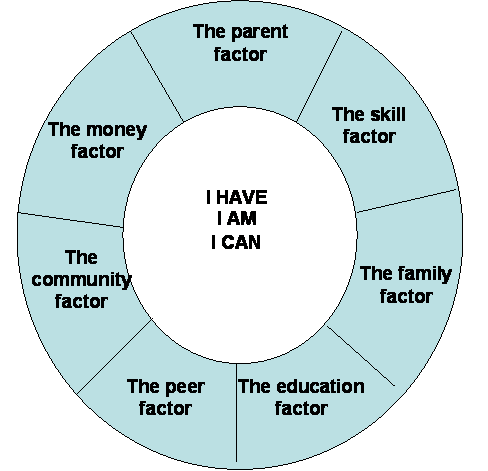
in the Face of Trauma Synopsis In this paper I focus on resilience in the face of trauma. Firstly, I look at factors that foster resilience in individuals, taking into account the work of Worsley and others in developing the Resilience Doughnut. I also explore resilience factors within families and then communities - exploring along the way what are the common factors for resilience in individuals, couples and communities. I also explore how resilience can be fostered in cross cultural communities and look at one of the programs being put in place to make communities more resilient in the face of natural and man made trauma. 2
What is trauma and what is resilience in the face of trauma? 3
Factors that foster resilience in the individual and the family 3.1
Optimistic Thinking
– Our view of ourselves, others & situations 3.4
What you have, what
you are & what you can do: The Resilience Doughnut
1 IntroductionA
significant body of research has been carried out in the area of resilience in
the face of trauma. This research has identified a number of factors that can
facilitate resilience in individuals, families and communities. Fundamentally,
these factors are strength based and look at enhancing an individuals, families
or communities strengths rather than identifying and cataloguing deficits and
attempting to rectify them. A number
of the factors that facilitate resilience are similar regardless of whether you
are looking at individuals or groups of people and focus around positive
thinking, connectedness, relationship, resources, skills & education.
Importantly, for organisations
working with communities in the developing world, these factors appear to apply
in cross cultural settings pointing the way to reducing the impact of trauma in
those communities. 2 What is trauma and what is resilience in the face of trauma?In looking at the question of resilience in the face of trauma it prompts the exploration of what we mean by both resilience and trauma. In keeping with the definition of Briere and Scott, who build on the definition provided in the DSM-IV-TR, a traumatic event is seen to be one where there is “actual or threatened death or serious injury, or other threat to one’s” own or another’s psychical integrity or psychological integrity. (Briere & Scott, 2006, p.3-4). Trauma can be human in origin e.g. rape, assault, war, or natural, e.g. flood, fire, earthquake or accidental e.g. a plane, car or train accident. These events can impact on individuals, families or entire communities without regard to culture or economic well being even though it is often the poorest that suffer the most. As for resilience Sandler et al state that “bereaved children who achieve high levels of competence and low levels of problems are considered to be resilient” (Sandler , Wolchik, Ayers, Tein, Coxe & Chow, 2008, p. 532). Likewise Masten describes resilience as people “succeeding in spite of serious challenges to development” (Masten, 1997, para 1). She went on to emphasise that “resilience does not mean ‘invulnerable’ or ‘unscathed!’” (Masten, 1997, para 4). Resilience
in this paper is understood to be: the
behavioral patterns, functional competence, and cultural capacities that
individuals, families, and communities use under adverse circumstances and the
ability to make adversity into a catalyst for growth and development (Hooyman
& Kramer, 2006, p. 66). Dr Michael Ungar, Principal Investigator with the Resilience Research Centre has a definition which emphasises the relational aspects of resilience by stating that "resilience is both an individual’s capacity to navigate to health resources and a condition of the individual’s family, community and culture to provide those resources in culturally meaningful ways" (Ungar, 2009, para. 3). The relational nature of resilience is also emphasised by Plants & Walsh who state that “resilience is produced by the interactions among a child, family, peers and community” (Plants & Walsh cited in Worsley, 2006, p.13). In the face of various trauma events it is apparent that there is variability in how resilient individuals or communities are and people will vary in their resilience in the face of the same trauma event. (Geldard & Geldard, 2002) In fact most people faced with a traumatic event do not go onto develop trauma symptoms demonstrating that resilience in the face of trauma is largely an inherent aspect of our humanity (The Australian Centre for Posttraumatic Mental Health, 2007). Likewise,
various trauma events have the ability to affect us at a deeper level than other
trauma events. In responding to the death of a child studies have shown that
parents of children who have died as a result of homicide have higher levels of
PTSD and lower levels of marital satisfaction, “and the least acceptance of
deaths” compared to those who had lost children as a result of accident and
suicide (Murphy, 2008, p.380). In
fact, “parents whose children died by suicide, compared with” parents of
children who died from homicide or accident, displayed “the lowest mean scores
on mental distress and PTSD and the highest mean scores on acceptance of death
and marital satisfaction”(Murphy, 2008, p.380).
3 Factors that foster resilience in the individual and the family3.1
Optimistic
Thinking – Our view of ourselves, others & situations
Optimistic thinking has been shown to be a key factor in promoting resilience. The way a person thinks directly impacts on “many critical abilities associated with resilience including:
The optimist will see bad events as transitory, they see the events as
being caused by issues that have solutions and that they are not responsible for
what has happened to them. In contrast the pessimist will see themselves as
somehow being responsible for the traumatic event, that every thing is bad and
that the situation is unlikely to get better (Worsley, 2006; Bonanno,
Boerner & Wortman, 2008; Archer & Fisher, 2008).
As pointed out by Worsley this research is important because it indicates that
key skills that enhance resilience can be taught and learned (2006). 3.2
A healthy
lifestyle
While
the data is purely descriptive it is apparent that a healthy lifestyle is also a
factor that is conducive to resilience. Healthy protective behaviors in this
regard were taken to include “exercise, eating a healthy diet, not smoking,
and moderate alcohol use.” Mothers and fathers studied post one of
their children’s death ,who were in poor health, were 3 times more
likely to report trauma symptoms while unhealthy fathers were “5 times more
likely to report trauma symptoms” (Murphy, 2008, p.381).
3.3
Our
place in Relationship: attachment as a facilitator of resilience for individuals
and families
As mentioned earlier, the factors that foster secure attachment also foster resilience. Parkes found while investigating attachment styles in bereavement that “adults who reported having secure attachments to their parents during childhood showed less grief and distress than did those who clung to and demonstrated separation distress with parental figures during childhood”(cited in Hooyman & Kramer, 2006, p. 27). 3.4
What you have,
what you are & what you can do: The Resilience Doughnut
Fig
1. (Worsley,2006, p.18) 4 Resilience and CommunityDeveloping
these themes and factors as facilitators of resilience there have been a number
of projects undertaken by international organisations
seeking to engender resilience in communities in the
developing world. These groups have also sought to identify the factors that
promote resilience and put them into a codified methodology so that communities
might enhance their own resilience. As with resilience in individuals it is
apparent that these methodologies work best when they focus on enhancing
strengths rather than trying to mitigate weaknesses. Table One: Thematic area
Components of resilience
(Twigg,
2007, p.9) To determine how applicable these tools are in developing
economies and in a cross cultural context, Tearfund, in association with the Disaster Risk Reduction
Interagency Coordination Group, has sought to pilot the Guidance Note in a
number of communities in a number of states within Africa and 5 Conclusion:Resilience is something every individual and group has to some extent. Some of these resilience factors include those that come as a result of our earliest attachments and how we have learned to think about ourselves and about others. Research has shown that increasing resilience, whether for individuals, families and communities, is about building on these strengths. The skills, education, social support and governance structures, that support individuals or communities facing traumatic events, are all factors that can be enhanced, taught or otherwise implemented. However, the research has also shown that one of the most powerful factors in mitigating trauma is to have a positive outlook about ourselves, the resources we have and the situations we are in. 6 ReferencesArcher, J.
& Fisher, H.. (2008) Bereavement & Reactions to Romantic Rejection: A
Psychobiological Perspective in Stroebe, M.S., Hansson, R.O., Schut, H., &
Stroebe, W. (Eds.). (2008). Handbook of
Bereavement Research and Practice: Advances in Theory and Intervention.
American Psychological Association. Egan, G. (2002) The Skilled Helper, A problem-management and Opportunity-Development Approach to Helping (7th Edition), Pacific Grove, California, USA: Brooks/Cole.
|
|
Send mail to
webmaster@shirepsych.com.au with
questions or comments about this web site.
|